
About 6 min readNovus Stream Solutions
A camera that keeps the pitch readable
Four August releases rebuilt the match camera around one question: can you see who has the ball and where the play is going? What changed, and why.
- Camera
- Feel
- Accessibility
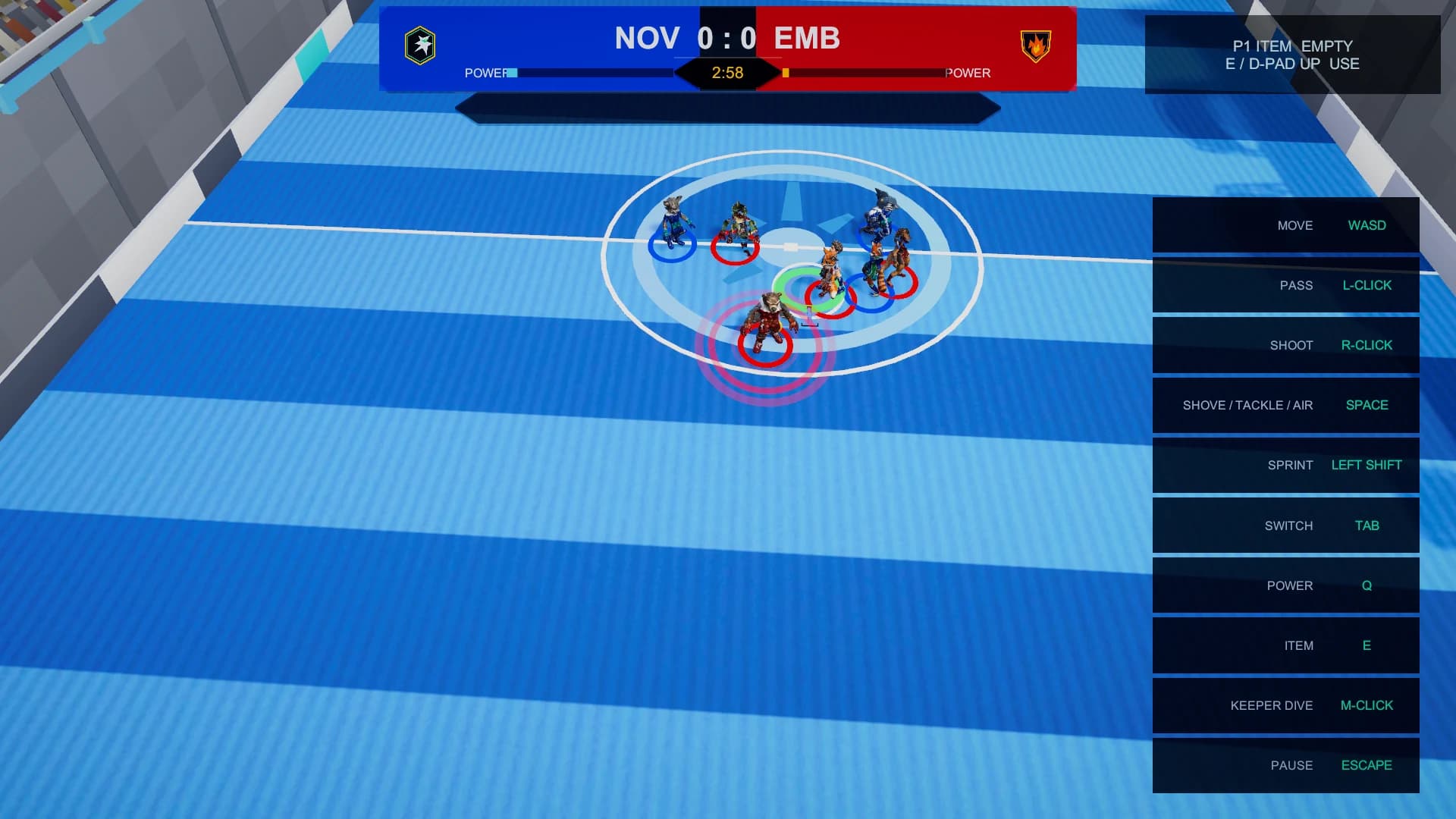
The release this is about
1720d9270d0c823f, shipped August 12, 2026. Definitive beta visual and mobile polish.
Arcade football lives or dies on one thing the player never thinks about: whether they can see what is happening. Who has the ball. Which team-mate is free. Whether the defender closing in is yours or theirs. When the camera gets that wrong, every other system in the game looks broken, because the player is reacting to a picture that does not show them the play.
Four releases in August were, in large part, about the camera. None of them was a single dramatic change. Each one fixed a specific way the picture was lying to the player, and together they turned a camera that framed the ball into one that frames the play. This note walks through what changed, in the order it shipped, and ends with what is still open.
The first problem: the camera was too close
Before 3ed11f981d57c26b the camera framed the ball so tightly that players filled the screen whatever size the pitch was. That release made the pitch larger and pulled the camera back to match, and the two were asked for together. A bigger pitch seen from the same distance would only have meant more running off screen. A camera further back over the old pitch would have shown a lot of empty grass. Changing both is what lets players read as athletes on a field.
The same release found three faults that only showed up once you could see the whole pitch. The ball was being drawn at two-fifths of its true size, so it seemed to rebound off nothing and pass through feet. Opposition and team-mates were bounded by a box measured for a smaller field, so nobody ever worked the wings. And keepers in a freshly opened arena stood well in front of their line. A tight camera had hidden all three.
The second problem: the camera left the stadium
Every camera view in the game is an offset from the play rather than a fixed position. That is what lets it follow the ball, and it is also what went wrong. As the ball drifted towards a touchline, the side-on view drifted with it, and with the ball on the near side the lens ended up outside the stadium, behind the wall and the stands, filming the match through the crowd. 2ef592aa46f042f6 holds the view inside the bowl.
The same investigation explained a stranger complaint: the stadium's props had been in the build all along, and almost none of them could be seen. Most stood inside the crowd or below the top of the wall, because the rule that kept scenery off the pitch said nothing about height. Fixing where the camera may stand and where the scenery may stand turned out to be one piece of work.
The third problem: one camera did not fit every view
The game offers several ways to watch a match: tactical, overhead, sideline, side, chase and first-person. The rebuild in 81bc6f7486025b9a pulled all of them back and constrained them around a flat window over the field, instead of an oversized sphere around a target point. A sphere is easy to write and hard to live with: it lets the lens swing into places that show nothing useful. A flat window matches what the player actually needs to see, which is the part of the pitch where the play is.
That release also guarded the first-person view against clipping through nearby geometry and against uncontrolled spins, and it stopped computer-controlled players from showing local-player numbers above their heads. A number over a player you do not control is information pointing the wrong way.
The fourth step: frame the play, not a point
The latest camera work, in 1720d9270d0c823f, retunes every match camera around active play, with smoother blending between targets and sightlines that stay safe inside each arena. The same release changed how computer-controlled team-mates behave around a loose ball: only the nearest eligible player chases it, and the rest hold width, depth and rebound positions instead of collapsing into a crowd.
That second change is a camera change in all but name. A camera can only show a readable picture if the players in it are spread out in a readable way. Six players converging on the ball is unreadable from any angle, and no amount of framing fixes it.
What readable means here
Readable is not the same as cinematic. A broadcast camera cuts, pushes in and chooses a story. A match camera in a game has a narrower job: it must keep the information the player needs on screen, all the time, from wherever the play goes. In practice that comes down to a short list.
- The ball and the player you control are always in frame, at a size where you can see which way they face.
- Likely receivers are visible, so a pass is a choice and not a guess.
- Both touchlines are reachable without the lens leaving the stadium.
- Team-mates are spread widely enough that the picture has shape.
- Pressing a direction moves your striker in the direction it looks like on screen.
Celebrations and replays are separate. A goal gets its own screen and a replay gets its own cinematic playback, and neither of those is allowed to change how the live match is framed. Speed in the live match should come from players and the ball, not from the camera inventing urgency.
Choosing a view, and reduced motion
The camera is part of match setup: Quick Match lets you choose clubs, lineup, arena, rules and camera, and a local versus match always uses one of the touchline views. Reduced motion and reduced effects are both settings in the current build, alongside touch sizing and colour-vision palettes, and Controls and accessibility lists them with the rest of the input options.
What this note does not claim
It does not claim the camera is finished. Every release above names what it fixed, and none of them says the framing is final. It does not claim broadcast-style direction or a camera per set piece. And it does not claim that every view suits every player: the first-person view is there for players who want it rather than as a recommendation.
If a view makes play harder to read, or makes you feel unwell, that is a defect against the goal described here and not a style choice. The feedback page is the place to say so, with the view you were using and the arena you were in.
How to judge it yourself
- Start a Quick Match from the game page on the tactical camera and play one half. Count how often the ball or your striker leaves the frame.
- Switch to the side-on view and play the ball along the near touchline. The stand should never come between you and the pitch.
- Play a local versus match and press forward on each side. Both strikers should run up the pitch as it appears on screen.
- Watch a loose ball. One team-mate should go for it and the others should hold their shape.
If all four hold, the camera is doing its job. If one does not, the release entries linked at the foot of this page describe exactly what was supposed to change.
The short version
A camera that keeps the pitch readable
A sixteen-second captioned summary of what the August camera releases changed and why.
Transcript
- 0:00The camera pulled back so players read as athletes.
- 0:04Every view stays inside the stadium bowl.
- 0:08Framing follows active play, not a fixed point.
- 0:12Movement follows the camera you are looking through.
Where to check this
Nothing above is written from memory. These are the pages and records each claim comes from.